
THE SOUL OF BOTANY: SCIENCE, SKIN AND THE ENERGETICS OF PLANTS
Since the days of ancient Egypt, when queens such as Cleopatra already used plant sap as part of their beauty rituals, the relationship between human beings and plants has been fundamental. Today, a botanical study of everyday cosmetics reveals that we use extracts from as many as 129 different plants belonging to 59 botanical families. Among…
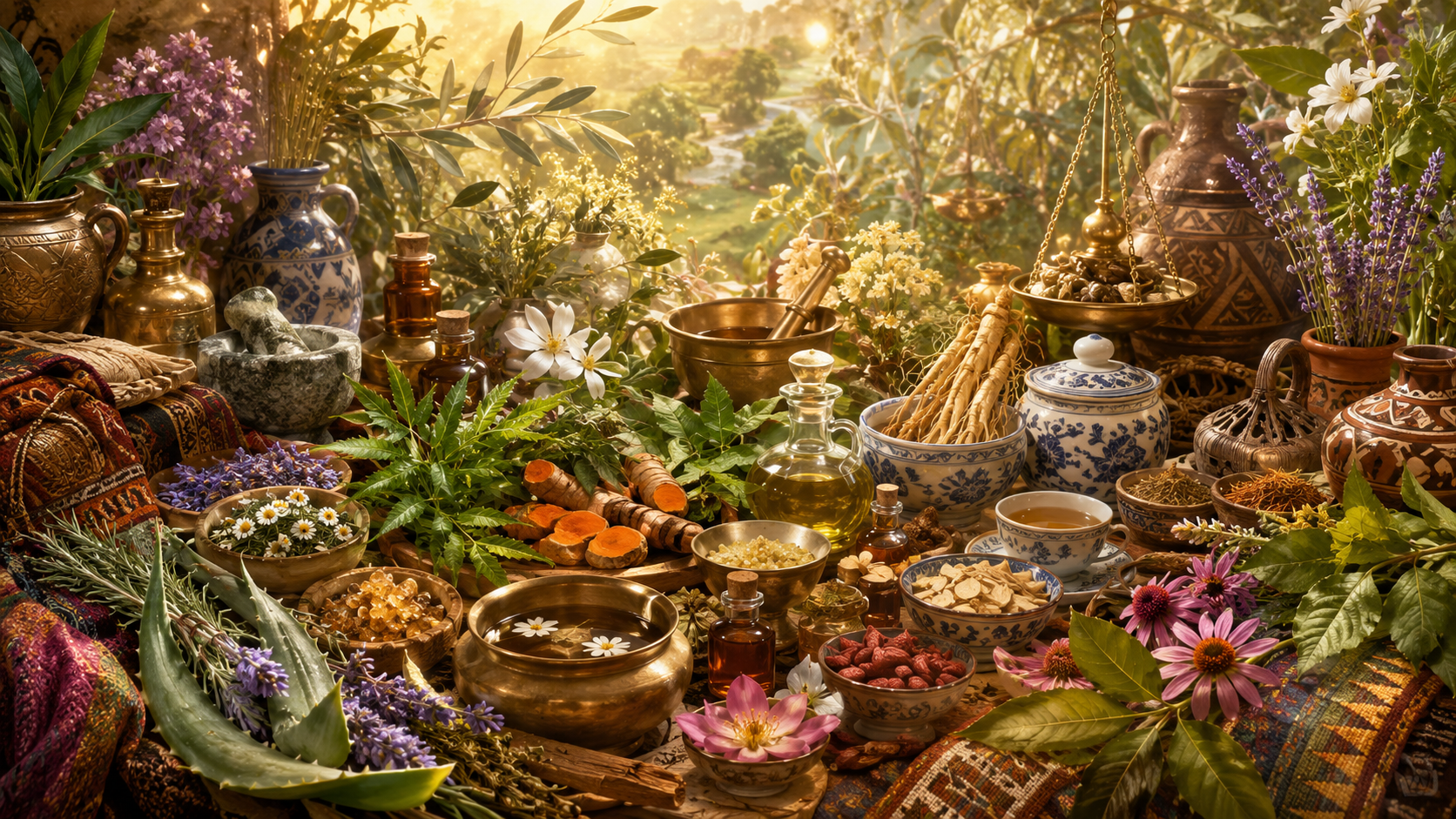
Read it as a cultural and cosmetic guide. The aim is to understand the origin, meaning and formulation of these ingredients more clearly, not to replace medical advice or promise therapeutic results.
Historical origins and cultural perspective
The relationship between plants and skin runs through very different civilisations. In ancient Egypt, plant-based ointments were already part of beauty and protection rituals. In the classical Mediterranean world, oils, resins and infusions were used both for hygiene and for preserving the body. In Asia, especially within Ayurveda and Chinese medicine, the skin was never seen as an isolated layer, but as a visible expression of a deeper balance.
That legacy helps explain why phytocosmetics still feel so compelling today. Not only because they offer useful ingredients, but because they preserve a way of observing skin, hair, climate and bodily rhythms with more context and less simplification.
How this knowledge was applied to skin and hair
In many cultures, plant-based cosmetics existed before the modern idea of cosmetics itself. They took the form of oils to soften sun-exposed skin, infusions to wash the hair, balms for overworked hands, or macerations linked to hygiene, protection and comfort.
Today, that heritage can be read with more care and more rigour: understanding what belongs to tradition, what belongs to contemporary formulation, and what genuinely makes sense in a routine centred on the skin or scalp.
Since the days of ancient Egypt, when queens such as Cleopatra already used plant sap as part of their beauty rituals, the relationship between human beings and plants has been fundamental. Today, a botanical study of everyday cosmetics reveals that we use extracts from as many as 129 different plants belonging to 59 botanical families. Among the most prominent are the Asteraceae, such as chamomile; the Rosaceae, such as rosehip; and the Lamiaceae, such as rosemary.
To understand the impact of plants, we must first look at our own anatomy. The skin is the largest organ in the human body and is made up of complex layers. In the epidermis, the outer layer, plants act on keratinocytes and melanocytes to help protect us from sunlight and ageing. In the dermis, the middle layer, plant-based active compounds stimulate fibroblasts, the cells responsible for synthesising the collagen and elastin that give the skin firmness and elasticity. Plants concentrate much of their “magic” in their seeds, fruits and flowers, providing us with polyphenols, flavonoids and vitamins.
In the world of extraction, it is essential to distinguish between two major groups: vegetable oils and essential oils. Vegetable oils are obtained by cold-pressing seeds or fruits. They are rich in fatty acids and may be applied directly to the skin to nourish it deeply. Essential oils, by contrast, are highly concentrated volatile extracts obtained through distillation. They contain the aroma and therapeutic properties of the plant, but they must always be diluted because they are extremely potent, and their use is generally discouraged during pregnancy.
However, the modern laboratory approach often overlooks a crucial dimension: herbal energetics. Ancient traditions such as Ayurveda and Traditional Chinese Medicine understand that plants are not merely collections of chemical compounds. They also possess qualities — heat, cold, dryness and moisture — that interact with the body’s vital energy, or Qi. In Ayurveda, for example, plants are assessed according to their rasa — taste —, virya — energetic temperature — and vipaka — post-digestive effect — in order to balance each person’s doshas. Holistic phytocosmetics therefore go beyond treating a visible symptom: they select the specific energy of each plant to restore a deeper harmony between body and mind.